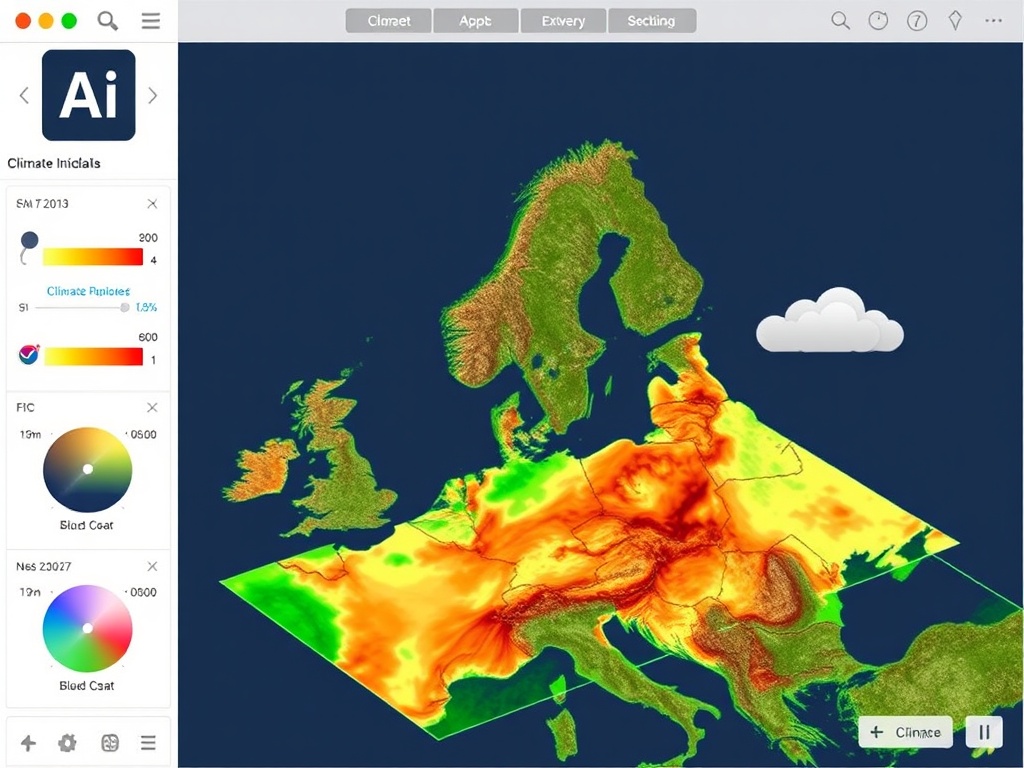
AI Apps for Climate Modeling Tools: Revolutionizing Our Understanding of a Changing World
As we navigate the complexities of climate change, it’s imperative that we leverage the latest advancements in technology to better understand and mitigate its effects. One such area gaining significant traction is the integration of Artificial Intelligence (AI) with climate modeling tools. In this article, we’ll delve into the world of AI-powered climate modeling apps, exploring their capabilities, benefits, and potential to reshape our understanding of a rapidly changing planet.
The Need for Innovative Climate Modeling
Climate change is one of the most pressing issues of our time. As global temperatures continue to rise, it’s crucial that scientists, policymakers, and businesses work together to develop effective strategies for reducing emissions and adapting to the consequences of climate change. To achieve this, we need powerful tools that can help us better understand the complex interactions between human activities, natural systems, and the atmosphere.
Traditional climate modeling approaches rely heavily on simplified models, often neglecting crucial factors like nonlinear feedback loops and chaotic behavior. The limitations of these methods are evident in their inability to accurately predict the timing and severity of extreme weather events, such as heatwaves, droughts, or floods.
The Rise of AI-Powered Climate Modeling
Enter Artificial Intelligence (AI), a revolutionary technology that’s transforming multiple industries, including climate modeling. By injecting machine learning algorithms into traditional climate models, researchers can now simulate complex systems with unprecedented accuracy and speed. This synergy between AI and climate modeling has given rise to a new generation of cutting-edge apps that are poised to revolutionize our understanding of the Earth’s climate.
Key Features of AI Apps for Climate Modeling
These innovative tools combine the strengths of machine learning with advanced climate modeling techniques, offering numerous benefits:
High-Resolution Simulations
AI-powered climate models can generate high-resolution simulations, capturing intricate details and complex interactions that traditional methods often overlook. This allows researchers to investigate the impacts of various scenarios, from modest emissions reductions to more drastic changes.
Scalability and Speed
Machine learning algorithms enable these apps to process vast amounts of data quickly and efficiently, making it possible to perform large-scale simulations in a fraction of the time required by traditional methods.
Uncertainty Quantification
AI models can quantify uncertainties associated with climate predictions, providing a more accurate representation of potential outcomes. This is crucial for policymakers who need reliable information to inform their decisions.
Data Integration and Fusion
These apps can seamlessly integrate disparate datasets from various sources, including satellite imagery, weather stations, and ocean buoys. This fusion of data enables researchers to create a more comprehensive picture of the climate system.
Notable Examples of AI Apps for Climate Modeling
Several pioneering projects have already leveraged AI in climate modeling, demonstrating its potential:
Climate Forecast System (CFS)
Developed by NASA’s Global Modeling and Assimilation Office (GMAO), CFS is a high-resolution climate model that utilizes machine learning to simulate the Earth’s atmosphere and oceans. This system has shown significant improvements in predicting weather patterns and seasonal forecasts.
Earth System Prediction Model (ESPM)
The ESPM project, led by the National Oceanic and Atmospheric Administration (NOAA) and the National Center for Atmospheric Research (NCAR), aims to develop a next-generation climate model that combines AI with traditional modeling techniques. The ESPM will enable researchers to simulate complex Earth system processes with unprecedented accuracy.
Climate Analytics Platform (CAP)
The CAP, developed by the European Centre for Medium-Range Weather Forecasts (ECMWF), is an innovative platform that integrates AI-powered climate models with cutting-edge data analytics. This tool enables researchers to analyze and visualize large datasets, facilitating a deeper understanding of climate phenomena.
The Future of AI Apps in Climate Modeling
As we continue to push the boundaries of what’s possible with AI in climate modeling, several trends are emerging:
Increased Complexity
AI-powered climate models will increasingly tackle more complex systems, such as coupled ocean-atmosphere simulations and multi-scale interactions.
Integration with Emerging Technologies
Expect AI apps to integrate with other innovative technologies, like quantum computing, the Internet of Things (IoT), and big data analytics platforms, further expanding their capabilities.
Open-Source Development
The open-source community will play a crucial role in driving the development of these AI apps, fostering collaboration and accelerating innovation.
Conclusion
The convergence of Artificial Intelligence and climate modeling has given rise to a new generation of powerful tools that are revolutionizing our understanding of a rapidly changing world. As we navigate the complexities of climate change, it’s essential that we continue to leverage these innovative technologies to develop more accurate, efficient, and effective climate models.
By embracing AI-powered climate modeling apps, we can:
- Enhance our predictive capabilities
- Better understand complex systems and interactions
- Inform more effective policy decisions
- Mitigate the impacts of climate change
As we look to the future, it’s clear that AI apps will continue to play a vital role in shaping our understanding of the Earth’s climate. With their unparalleled capabilities and flexibility, these tools have the potential to transform the way we approach climate modeling, paving the way for a more sustainable and resilient future.
References:
- NASA (2026). Climate Forecast System (CFS).
- NOAA (2026). ESPM: Next-Generation Climate Modeling.
- ECMWF (2026). CAP: The Climate Analytics Platform.